Showing posts with label minimum wage laws. Show all posts

Monday, October 5, 2009

The minimum wage hike has driven the wages of teen employees down to $0.00.

The October 3, 2009 Wall Street Journal editorial "The Young and the Jobless" suggests recent increases in the U.S. minimum wage have increased unemployment, especially for teenagers:
Yesterday's September labor market report was lousy by any measure, with 263,000 lost jobs and the jobless rate climbing to 9.8%. But for one group of Americans it was especially awful: the least skilled, especially young workers. Washington will deny the reality, and the media won't make the connection, but one reason for these job losses is the rising minimum wage.

Earlier this year, economist David Neumark of the University of California, Irvine, wrote on these pages that the 70-cent-an-hour increase in the minimum wage would cost some 300,000 jobs. Sure enough, the mandated increase to $7.25 took effect in July, and right on cue the August and September jobless numbers confirm the rapid disappearance of jobs for teenagers.

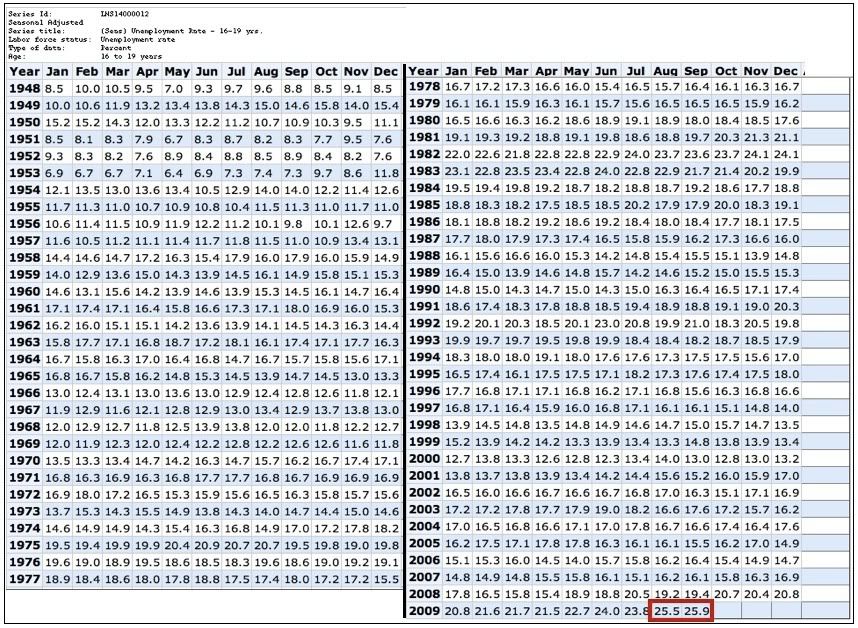
The September teen unemployment rate hit 25.9%, the highest rate since World War II and up from 23.8% in July. Some 330,000 teen jobs have vanished in two months. Hardest hit of all: black male teens, whose unemployment rate shot up to a catastrophic 50.4%. It was merely a terrible 39.2% in July.

The biggest explanation is of course the bad economy. But it's precisely when the economy is down and businesses are slashing costs that raising the minimum wage is so destructive to job creation. Congress began raising the minimum wage from $5.15 an hour in July 2007, and there are now 691,000 fewer teens working.

As the minimum wage has risen, the gap between the overall unemployment rate and the teen rate has widened, as it did again last month. (See nearby chart.) The current Congress has spent billions of dollars—including $1.5 billion in the stimulus bill—on summer youth employment programs and job training. Yet the jobless numbers suggest that the minimum wage destroyed far more jobs than the government programs helped to create.

Congress and the Obama Administration simply ignore the economic consensus that has long linked higher minimum wages with higher unemployment. Two years ago Mr. Neumark and William Wascher, a Federal Reserve economist, reviewed more than 100 academic studies on the impact of the minimum wage. They found "overwhelming" evidence that the least skilled and the young suffer a loss of employment when the minimum wage is increased. Whatever happened to President Obama's pledge to follow the science? Democrats prefer to cite a few outlier studies known to be methodologically flawed.

State lawmakers are also at fault. At least 10 states have raised their minimum wages above the federal level in the last decade, largely in response to union lobbying and in the name of helping the working poor. Four states with among the highest wage rates are California, Massachusetts, Michigan and New York. Studies have shown in each case that their wage policies killed jobs for teens. The Massachusetts teen employment rate sank by one-third when the minimum wage rose by 88% between 1995 and 2008.

According to new numbers from the Labor Department, in 2008 only 1.1% of Americans who work 40 hours a week or more even earned the minimum wage. In other words, 98.9% of 40-hour-a-week workers earn more than the minimum. The data also show that teenagers are five times more likely to earn the minimum wage than adults. Minimum wage jobs are nearly all first-time or part-time jobs, and an estimated two of every three minimum wage workers get a pay raise within a year on the job.

Study after study reveals that there are long-term career benefits to working as a teenager and that these benefits go well beyond the pay that these youths receive. A study by researchers at Stanford found that those who do not work as teenagers have lower long-term wages and employability even after 10 years. A high-wage society can only come by making workers more productive, and by destroying starter jobs the minimum wage may reduce long-term earnings.

Another recent study across 17 OECD nations, also by Messrs. Neumark and Wascher, found a highly negative association between higher minimum wages and youth employment rates. But it also concluded that having a starter wage, well below the minimum, counteracts much of this negative jobs impact. If Congress won't suspend its recent minimum wage hike, it should at least create a teenage wage of $4 or $5 an hour to help put hundreds of thousands of teens back to work. White House chief economic adviser Larry Summers has endorsed this in the past. Without this change, expect the teen unemployment to remain very high for a long time.

The wonder of it all is that liberals still call "progressive" a policy that has driven the wages of hundreds of thousands of the lowest skilled workers down to $0.00.

The Minimum Wage & Teen Unemployment

The October 5, 2009 article "Record Teen Unemployment: Only WSJ Seriously Looks At Minimum-Wage Hikes As Cause," on the politically conservative newsbusters.org suggests that recent increases in the minimum wage have increased unemployment, especially for teenagers:
Based on the data, the current job situation for teenagers in America is the worst on record.

According to Uncle Sam's Bureau of Labor Statistics:

Seasonally adjusted teenage unemployment hit 25.9%. That is the highest rate in the nearly 62 years BLS has been reporting this number. The previous record was last month's 25.5%. The record before that was 24.1% in November and December of 1982. A graphic of the complete history of the teenage unemployment rate that will open in a new window is here.

Unemployment among black teens not enrolled in school is over 50%.

The rate among 20-24 year-olds is also alarmingly high at 15.1%.

Almost alone among establishment media publications -- and even then in an editorial, not a regular news report -- the Wall Street Journal commented on this distressing set of circumstances, identified the most likely cause of the problem, and worried about its longer-term consequences:

Washington will deny the reality, and the media won't make the connection, but one reason for these job losses is the rising minimum wage.

Earlier this year, economist David Neumark of the University of California, Irvine, wrote on these pages that the 70-cent-an-hour increase in the minimum wage would cost some 300,000 jobs. Sure enough, the mandated increase to $7.25 took effect in July, and right on cue the August and September jobless numbers confirm the rapid disappearance of jobs for teenagers.

The September teen unemployment rate hit 25.9%, the highest rate since World War II and up from 23.8% in July. Some 330,000 teen jobs have vanished in two months.

.... The biggest explanation is of course the bad economy. But it's precisely when the economy is down and businesses are slashing costs that raising the minimum wage is so destructive to job creation. Congress began raising the minimum wage from $5.15 an hour in July 2007, and there are now 691,000 fewer teens working.

.... Congress and the Obama Administration simply ignore the economic consensus that has long linked higher minimum wages with higher unemployment. Two years ago Mr. Neumark and William Wascher, a Federal Reserve economist, reviewed more than 100 academic studies on the impact of the minimum wage. They found "overwhelming" evidence that the least skilled and the young suffer a loss of employment when the minimum wage is increased. Whatever happened to President Obama's pledge to follow the science?

.... Study after study reveals that there are long-term career benefits to working as a teenager and that these benefits go well beyond the pay that these youths receive. A study by researchers at Stanford found that those who do not work as teenagers have lower long-term wages and employability even after 10 years. A high-wage society can only come by making workers more productive, and by destroying starter jobs the minimum wage may reduce long-term earnings.

.... If Congress won't suspend its recent minimum wage hike, it should at least create a teenage wage of $4 or $5 an hour to help put hundreds of thousands of teens back to work. White House chief economic adviser Larry Summers has endorsed this in the past. Without this change, expect the teen unemployment to remain very high for a long time.

The wonder of it all is that liberals still call "progressive" a policy that has driven the wages of hundreds of thousands of the lowest skilled workers down to $0.00.

The chances of a teen minimum getting through Congress, let alone being signed by the president, are unfortunately slim and none. The objection to the idea in the 1970s was that it would encourage employers to "fire the father and hire the son." Perhaps that fear was slightly justified in the case of interchangeable blue-collar jobs decades ago, but it's hard to believe that it would be a problem in today's much more technical and skill-based economy.

The Journal is virtually alone in noting the teen unemployment/minimum wage hike correlation. A September 23 AP report, while noting how ineffectual federally funded teen job-finding efforts were this summer, doesn't even mention the minimum wage. A September 4 story on the topic at the New York Times by Catherine Rampell devotes all of one sentence to the possibility that minimum-wage hikes might be largely to blame ("Increases in the minimum wage may have made employers reluctant to hire teenagers, said Marvin H. Kosters, a resident scholar emeritus at the American Enterprise Institute"), and doesn't even bother to evaluate it. Instead, Rampell tries to pin the blame on older workers reluctant to retire (even though there has been a dramatic spike in workers retiring to take Social Security benefits this year), and the higher percentage of kids in college (that shouldn't affect summer or Christmastime availability).

One possibly valid point Rampell raises is that "the ability of more young people to rely on family may allow them to be pickier about jobs and therefore to stay out of work longer than they did in previous recessions." My interpretation of this is that "too many overprotective parents are shielding their kids from the 'mean, cruel world.'" More kids than ever aren't taking their first job, even in good times, until they have stopped going to school either after high school or college. Part of the blame should probably also go to high school extracurriculars that demand what I believe are often excessive summertime commitments (e.g., band, sports). I'm not sure that parents, or the schools, are doing kids any favors by keeping them away from the early lessons one can learn in exposure to the working world.

Cross-posted at BizzyBlog.com.

—Tom Blumer is president of a training and development company in Mason, Ohio, and is a contributing editor to NewsBusters

Friday, September 4, 2009

How workers get stiffed out of pay

In the September 3, 2009 U.S. News & World Report article
"How the Lowest-Paid Workers Get Ripped Off," Liz Wolgemuth reports that employers are cheating some workers out of wages they legally earned. Regulation is sometimes needed to improve market outcomes when the marketplace fails to provide socially desirable ones.
In large cities like Chicago, Los Angeles, and New York, there's a good chance that the employee mopping up drips at the car wash, the delivery driver at the nearby gourmet grocery store, and the temp worker hired to do janitorial work are not being paid much. It turns out, there's also a good chance they are not even being paid what they've earned.

According to a new study, the average low-wage urban worker earning $339 a week is cheated out of $51 of that amount by an employer committing one or more workplace violations--such as paying less than minimum wage, refusing overtime pay, requiring off-the-clock work, or preventing workers compensation claims. Whether damning proof of the government's inability to adequately enforce labor laws or evidence of a need for stronger standards, the report offers insight into the working lives of an often under-the-radar demographic.

The study, funded by the Joyce, Haynes, Ford, and Russell Sage foundations, is based on interviews with 4,387 low-income workers--39 percent unauthorized immigrants, 31 percent authorized immigrants, and 30 percent U.S.-born citizens--in the first half of 2008. The median hourly wage for workers surveyed was $8.02, and the workers were in a wide variety of industries, including manufacturing, construction, food service, and child care. Employing a method that uses social networks to recruit participants, the study focused on workers who tend to be the most difficult to survey. The questions asked were aimed at gaining accurate information about employer policies from workers who might not understand the law, and surveys were translated into languages that included Hindi, Urdu, Bengali, Polish, and Haitian Creole.

More than two thirds of the workers surveyed had experienced at least one pay-related violation within the previous workweek, according to the study. Nearly a quarter worked off the clock and were rarely paid for it. And 76 percent of workers who had worked overtime were not paid the overtime rate, as required by law. More than two thirds of workers entitled to lunch breaks had either not received them, had them shortened, had been interrupted, or continued to work through their break.

More violations were found in certain industries than in others. Minimum wage violations were most common in apparel and textile manufacturing, personal and repair services, and in private households. Violations were lower in residential construction, social assistance and education, and home healthcare. Employees of businesses with more than 100 employees experienced violations less often than those who worked at smaller businesses.

Study coauthor Ruth Milkman, a sociologist at University of California-Los Angeles, says the study results provide convincing evidence that the enforcement of labor laws has been very limited. "In that segment of the labor market, it also appears that employers have realized that enforcement is extremely unlikely and they can do this stuff without much fear of consequences," Milkman says.

It's not clear how violations affecting low-wage workers compare with those who are paid more. Milkman suspects that overtime violations extend to groups of higher-earning workers. The researchers found that women, immigrants, and people of color were disproportionately more likely to experience a violation. Three quarters of the workers surveyed had a high school degree or less. Foreign-born workers were nearly twice as likely to experience minimum wage violations, and foreign-born Latino workers had the highest minimum wage violation rates of any ethnic or racial groups.

The study's authors argue that "the best inoculation against workplace violations is ensuring that workers know their rights, have full status under the law to assert them, have access to sufficient legal resources, and do not fear retaliation." This is, they point out, a near impossibility for unauthorized immigrant workers. "Any policy initiative to reduce workplace violations must prioritize equal protection and equal status in national immigration reform, and ensure status-blind enforcement of employment and labor laws," they write.

In the existing labor market, employers who hire illegal immigrants benefit from an unnatural balance of power, since undocumented workers have little leverage with employers who violate the regulations of the formal labor market, says Will Wilkinson of the Cato Institute. He believes there needs to be much greater integration in the labor market in North America and policies that give undocumented immigrants the status to live and work here.

According to the New York Times, Labor Secretary Hilda Solis said her department was hiring 250 additional wage-and-hour inspectors. But greater enforcement of the existing workplace standards could complicate the route to employment for many illegal immigrants because they often rely on jobs that are below minimum wage as entry points in the U.S. job market and use those jobs to gain the skills to reach higher pay levels, Wilkinson says.

Milkman tells of interviewing a hotel worker whose supervisor would enter hotel rooms before her and take the tips that had been left for her. The worker also was required to work more hours than she was paid for. When she complained, she was essentially fired--told her services were no longer needed.

Friday, July 24, 2009

Minimum wage hike: More money or fewer jobs?

According to "Minimum wage hike: More money or fewer jobs?", a July 24, 2009 CNNMoney.com article by Aaron Smith:
On Friday the federal minimum wage jumps to $7.25 an hour from $6.55. Economists differ as to whether that will hurt or help low-income workers.

NEW YORK (CNNMoney.com) -- On Friday, the federal minimum wage rises for the third year in a row, sparking the perennial argument among economists: Will it help workers at the bottom of the ladder, or will it kill their jobs?

The U.S. minimum wage goes to $7.25 an hour, from $6.55, according to the U.S. Department of Labor. Most states have their own minimum wage, and employers are required to pay whichever is higher. That means minimum wage workers will get a raise in 29 states. In the remaining 21 states and Washington, D.C., they'll see no change.

In some states, the increase will be more modest. In New York, the state minimum wage is $7.15 an hour, so workers there will be paid an extra dime an hour, which means another $4 for a 40-hour week. But in states like Georgia, Virginia and Texas, workers are paid the current federal minimum of $6.55, so they'll get the largest raise of 70 cents, which translates into a $28 bump for a full-time week, or more than $1,400 a year.

Injecting money into the economy?
Kai Filion, an economist with the Economic Policy Institute in Washington, estimated that more than 2.8 million workers will have their wages lifted to $7.25 an hour on Friday. More than 1.6 million workers will also be indirectly affected, according to Filion, meaning their above-minimum wages will increase as the rising tide lifts all boats.

That adds up to nearly 4.5 million workers who would get a raise. The impact varies widely from state to state, depending on state minimum wages and population. In New York, with its $7.10-an-hour state minimum, 63,000 workers would be directly impacted, according to the EPI, compared with 632,000 workers in Texas.

"Because it's not a big increase, any impact will be modest, but it will be good," said Heidi Shierholz, a minimum wage expert with the EPI. "You're seeing people say this is a wrong time to do this, but I think that is entirely wrong-headed. They could not have planned this for a better time."

Based on Filion's estimates, the wage increase will inject $5.5 billion worth of extra spending into the economy over the next year.

"It gets additional money to low-wage workers," said Shierholz. "These are workers who are mostly struggling to get by and will spend that extra cash. This is actually stimulus."

Or fewer jobs for low-wage workers?
Back in 2007, before the current recession began, Congress passed a bill to increase the minimum wage, which was then $5.15 an hour, three times over three years.

Some economists believe that the Friday increase couldn't be happening at a worse time. The U.S. economy lost nearly 3.4 million jobs in the first half of 2009, which is more than the 3.1 million lost in all of 2008.

Suzanne Clain, professor and living wage expert at the Villanova School of Business in Pennsylvania, said that increasing the minimum wage would create additional financial hardships for employers, driving the nationwide unemployment rate above its current 9.5%.

"My feeling is that increasing the minimum wage is going to put additional strain on the economy," she said. "Additional jobs will be lost as a result. It puts stress on employers who are currently having very small profit margins."

Clain conducted an analysis showing that the 13 states with the highest minimum wage -- exceeding the upcoming federal minimum of $7.25 an hour -- experienced higher unemployment levels than the other 37 states. She said the unemployment rates were higher by an average of between 1.75% and 2% in those 13 states during the three-month period ending in May.

"Raising minimum wage rates will generally discourage businesses from employing people," Clain said. "We're already suffering from a downturn phase."

What about the waitresses?
Regardless of whether Friday's increase has a beneficial or negative effect on minimum-wage workers, there is one group that it always seems to leave behind, according to the National Employment Law Project: waiters, waitresses and other workers who rely on tips.

NELP, a New York and Washington-based advocacy group for low-wage workers, released a recent study highlighting the fact that the minimum wage for tip workers has remained frozen at $2.13 an hour since 1991. According to NELP, the buying power of this wage has fallen 36% over the last 18 years.

"This disproportionately affects women," said Raj Nayak, a lawyer with NELP. "Waiters around the country have three times the poverty level of other workers. It's hard to depend on tips."

To NELP, the solution is obvious: Raise the minimum wage for tipped workers. In the study, the group said the federal government could follow the lead of some 13 states that guarantee tipped workers 60% of the minimum wage, which was actually a federal policy until 20 years ago.

Better yet, the study suggests, the government could extend the same federal minimum wage to tipped workers as to any other wage earners, noting that this is already practiced in seven states, including California and Nevada.

A Brief History of the Minimum Wage


"A Brief History of the Minimum Wage" by Laura Fitzpatrick was published in TIME magazine on July 24, 2009:

With the U.S. trillions of dollars in the hole, 70 cents an hour sounds like chump change. But it's a big boost for the millions of workers who earn that much extra as of July 24. The increase is the third and final uptick in a hike that has since 2007 boosted the federal minimum wage from $5.15 to $7.25. In total, the extra $2 and change translates into a yearly raise of some $4,400 for a full-time minimum-wage worker, nosing his or her family of four above the poverty line.

The minimum wage was first instituted in Australia and New Zealand in the 1890s in response to frequent, bitter strikes and was adopted by Massachusetts in 1912 to cover women and children. With voters seeking a bulwark against the Great Depression, wage-hour legislation was an issue in the 1936 Presidential race. On the campaign trail, a young girl handed a note to one of Franklin Roosevelt's aides asking for help: "I wish you could do something to help us girls," it read. "Up to a few months ago we were getting our minimum pay of $11 a week...Today the 200 of us girls have been cut down to $4 and $5 and $6 a week."

Roosevelt rode back into office in part on a promise to seek a constitutional way of protecting workers; in 1923, the Supreme Court had struck down a Washington, D.C., minimum-wage law, finding it impeded a worker's right to set his own price for his labor. The first federal minimum-wage law, the Fair Labor Standards Act, passed in 1938, with a 25-cent-per-hour wage floor and a 44-hour workweek ceiling for most employees. (It also banned child labor.) Outside of Social Security, said Roosevelt, the law was "the most far-sighted program for the benefit of workers ever adopted." Wages must ensure a "minimum standard of living necessary for health, efficiency and general well-being," the act stipulated, "without substantially curtailing employment."

Ever since, however, critics and supporters have slugged it out over the minimum wage: some say it destroys jobs by making it too expensive to keep workers. University of California professor David Neumark estimates that the July 24 hike will end up costing some 300,000 jobs for young adults and teens by making their employment prohibitively expensive for enterprises already facing rapidly eroding profit margins.

Other economists note, however, that because a majority of minimum-wage earners work in outsourcing-resistant service jobs, businesses will have a hard time handing out pink slips en masse. Researchers at the University of California at Berkeley found that after an 80-cent New Jersey minimum wage hike in 1992, employment in the state's fast-food restaurants rose slightly faster than in Pennsylvania, where the minimum wage did not change. (The law's effects showed up, instead, in prices: the tab at New Jersey fast-food restaurants grew about 4% faster than at greasy spoons in Pennsylvania.) Instead of killing jobs, minimum wage supporters argue, the wage floor increases productivity and boosts consumer purchasing power. The Economic Policy Institute estimates that the July 24 hike to $7.25 will, over the course of the next year, pad consumer spending by more than $5.5 billion.

As a result of the sparring, the value of the minimum wage in real dollar terms has risen and fallen on political tides, peaking in 1968 when an hour's pay bought nearly 5 gal. (19 L) of gas. By 2006, it paid for less than 2 gal. (8 L); meanwhile, some states raised their own standards (Washington mandates $8.55 an hour). Thirty-one states will have to increase their minimum wages as a result of the July 24 increase, while 19 states and Washington, D.C. already had a minimum wage of $7.25 or higher.

Supporters of the boost say it will help the country's neediest at a time when they have been falling further and further behind. From 1973 to 2007, as the minimum wage fell 22% in real dollars, domestic corporate profits jumped more than 50%—bloating the gap between rich and poor and fueling calls for a $10-an-hour "living wage" by 2010. For now, though, an extra 70 cents is as good as it gets.

Thursday, July 23, 2009

Minimum wage hike could threaten low earners' jobs


According to "Minimum wage hike could threaten low earners' jobs," a July 23 article by Associated Press writer Dionne Walker, the upcoming increase in the U.S. federal minimum wage may increase unemployment:

A federal minimum wage increase that takes effect Friday could prolong the recession, some economists say, by forcing small businesses to lay off the same workers that the pay hike passed in better times was meant to help.

The increase to $7.25 means 70 cents more an hour for the lowest-paid workers in the 30 states that have lower minimums or no minimum wage. It also means higher costs for employers who feel they've already trimmed all their operating fat.

"How will they absorb the increase?" said Rajeev Dhawan, director of Georgia State University's Economic Forecasting Center. "They will either hire less people or they will do less business."

More than in any period before, businesses are likely to lay off employees and reduce hours, further fueling the economic slump in states seeing double-digit unemployment rates, fiscal conservatives and some economists say.

Minimum wage advocates counter the wage bump will keep more working poor afloat, and say more increases are needed to help stimulate consumer spending and strengthen businesses in the long run.

It's an old policy debate that resurfaced when Congress passed the increase two years ago and has taken on urgency as the nation's fiscal funk has deepened.

In the end, it's the workers and their employers who find themselves caught in the middle.

At Bench Warmers Bar and Grill in the southeast Kansas farming town of Chanute (pronounced sha-NOOT), owner Cathy Matney has decided to let some of her dishwashers go rather than pay all 22 of her employees more.

"It's bad timing," said Matney, whose waitresses and cooks will have to pitch in with scrubbing pots and pans. "With the economy like this, there's a lot of people who are out of work and this is only going to add to it."

Ryan Arfmann, who owns a Jamba Juice shop in Idaho Falls, Idaho, will be cutting hours to his staff, which is made up largely of college students, high schoolers and homemakers who want to make a few bucks.

"Am I going to fire anybody, no," Arfmann said. "But kids understand there's going to be hours cut."

Arfmann said he wishes the increase was spread out over a few more years, to make it easier for him to absorb the costs. He also is concerned that he'll end up having to give everybody raises just to maintain pay differentials between employees.

"People who are already getting paid above $7.25 are going to feel like they need raises as well," he said. "It's harder for me to reward employees that are doing well because of minimum wage being so high."

Backers of the increase say it's long overdue for millions of the nation's working poor. Rep. George Miller, D-Calif., authored the 2007 minimum wage legislation, which increased pay for the first time in a decade.

"A higher minimum wage helps working families' budgets and results in increased spending on local business, which is good for everyone," Miller said in an e-mail. He did not say whether he would have pushed to raise the minimum wage in an economic climate like the current one, and he did not immediately respond to a message left Thursday with his spokesman.

Miller's view is a tough sell to employers of minimum wage workers — from hotels to daycares to burger chains — who find themselves having to cut larger paychecks as their revenues continue to shrink. The effects could be especially harsh in the seven states — Alabama, Florida, Georgia, Indiana, North Carolina, South Carolina and Tennessee — where the pay increase coincides with double-digit unemployment.

"Wherever you have the higher unemployment rates, that's where the business conditions are bad — and that's where a minimum wage increase will have an impact on the negative side," said Dhawan, the economist at Georgia State.

Dhawan said the strain could be felt equally in metropolitan areas, where fast-food chains and franchises employ large numbers of minimum wage workers, and in smaller towns where the bulk of the work force may be concentrated in one, low-earning sector.

Fewer workers employed, meanwhile, reduces the amount of money in circulation — dampening any consumer spending spike the wage boost could have created, Dhawan said.

"The increasing power from the higher wages will be swamped by the losses from the people who lost jobs," he said.

Marilynn Winn, an Atlanta woman who earns $6.75 an hour — a couple of dimes more than the current $6.55 federal minimum — driving cars between auto auctions, worries the pay boost could lead her boss to make cuts, especially to older workers like herself.

Still, she said she'd be grateful for the raise if she gets to keep her job.

"We could use more, the more the better," said Winn, 58.

Sara Campbell, who earns roughly $786 a month cleaning event spaces in Atlanta, said she's unlikely to spend any money she gets from the minimum wage increase, especially since she worries her hours will get cut.

"You never know," she said. "You might lose your job. They might start laying off and if they lay off, I'll have something saved up."

Played out across enough businesses, that pattern could stunt economic recovery nationwide, said Moody's economist John Lonski.

"You're going to get fewer jobs created," said Lonski, who predicted national unemployment would peak at 10.5 percent in the first quarter of 2010. "It's not a backbreaker for the U.S. economy, but it doesn't help stabilize employment, especially since most businesses now suffer from much lower than expected sales."

It's hardly the first time a wage increase has prompted doom and gloom predictions from economists, who point to conventional business thinking that supports the idea that higher costs plus lower revenue equals a shrinking work force.

More upbeat predictions suggest the wage increase could actually play a role in turning around the nation's finances. Labor Secretary Hilda Solis said Thursday that the wage increase will generate an extra $5.5 billion in consumer spending over the next year.

Economists have largely overlooked the positive effect on consumer buying power, according to Holly Sklar, senior policy adviser for Let Justice Roll, a national campaign aimed at increasing the minimum wage to $10 by 2010.

A further wage increase could eventually become a reality: One of President Barack Obama's campaign promises included raising the minimum wage to $9.50 an hour by 2011.

"You can't have an economy that's based heavily on consumer purchasing power, and at the same time, not pay the consumer enough to live on," Sklar said.

Saturday, May 24, 2008

Minimum Wage Laws


INSERT DIAGRAM HERE

The Minimum Wage

Should we have a minimum wage in the United States?

Most people who support minimum wage laws feel they are necessary to ensure that unskilled workers have enough income to provide for themselves and their families. This is a reasonable societal goal. However, most economists argue that minimum wage laws are a lousy way to achieve that goal. We can use supply and demand analysis to explain why.

Minimum wage laws are applicable in the market for unskilled workers. (Highly skilled workers, such as doctors and lawyers, do not work for minimum wage.) The forces of supply & demand exist in the market for unskilled workers. The price of unskilled workers is the hourly wage that they are paid. At the equilibrium wage, the number of unskilled workers desiring a job equals the number of jobs offered by employers. The concern in this market is that this equilibrium wage does not provide sufficient income for these workers. Minimum wage laws attempt to increase the income of unskilled workers by requiring employers to pay these workers a higher wage than they would in the absence of the law.

What does supply & demand analysis suggest will be the outcome of this policy?

A minimum wage is a type of price control referred to as a price floor. The law does not allow the price to drop beneath the floor. The minimum wage is necessarily above the equilibrium wage. (If it were not, there would be no need for the minimum wage law.) At prices above equilibrium, however, the quantity of unskilled labor supplied (i.e., the number of people willing to work at that wage) exceeds the quantity of unskilled labor demanded (i.e., the number of unskilled jobs offered by employers). Thus, at prices above equilibrium, there is a surplus of unskilled labor. Some of the workers are unemployed (i.e., not working) or underemployed (i.e., not working as much as they would like).

Has the minimum wage accomplished our objective of providing unskilled workers with more income? The answer is "yes" and "no." The unskilled workers who have jobs are better off because they are earning a higher wage. Yet, some of the workers who would have been employed in the absence of the minimum wage law are unemployed with the minimum wage laws. Have we helped these unskilled workers by instituting a policy that provides incentives for employers to reduce the number of unskilled jobs?


Most economists oppose minimum wage laws. They oppose them because they are inefficient at achieving the stated objective. If you support the idea of providing unskilled workers with more income, there are alternatives to the minimum wage that probably are more efficient.


Alternatives to the Minimum Wage

• Give unskilled workers more income. (After all, the problem is that unskilled workers do not have enough income, right?)
• Give unskilled workers in-kind transfers (i.e., provide them with food, clothing, housing, medical care, etc.)
• Provide unskilled workers with education & training (so they can obtain skills). Economists generally like this option. The workers who obtain skills are more productive and consequently earn more income. Education & training also reduces the supply of unskilled workers. (They become skilled workers.) The supply curve for unskilled workers shifts left. Other things equal, the new equilibrium in the market for unskilled workers occurs at a higher wage. Education & training programs benefit the workers who receive the training (because they become more productive) and those workers who do not receive the training (because the supply of unskilled workers decreases). Wages for all of these workers increase. (Remember our goal is to increase the income of these workers.)